

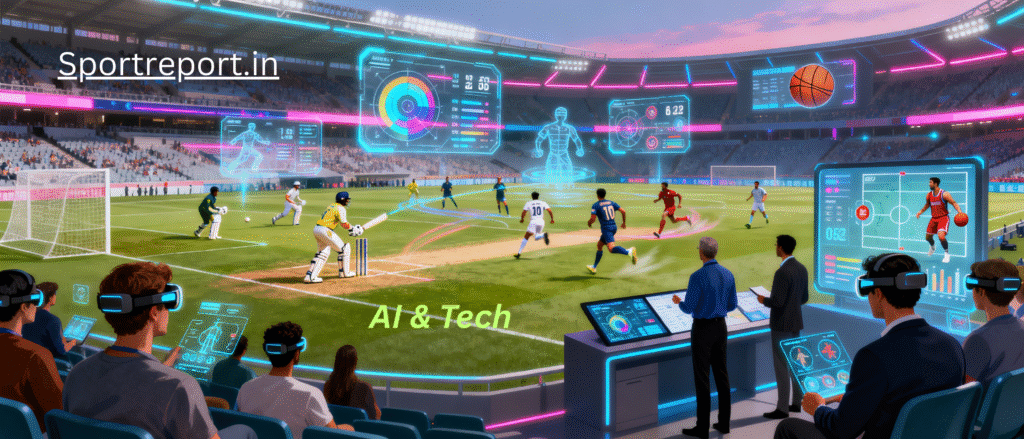
In the high-stakes world of modern sports, victory is no longer determined solely by physical prowess and raw talent. A silent, digital revolution is underway in locker rooms, training facilities, and front offices across the globe, powered by Artificial Intelligence (AI), machine learning, and cutting-edge Sports Technology. From enhancing athletic performance to securing digital infrastructure and creating immersive fan experiences, AI is fundamentally reshaping every facet of the sports industry. This isn’t about replacing the human element; it’s about augmenting it, creating a new era of Sports Innovation where data is the ultimate coach and algorithms are the unseen playmakers.
At SportReport.in, we are dedicated to bringing you the latest news and analysis on how these technological advancements are transforming the games we love, from cricket to football and beyond.
The Rise of Generative AI in Sports Strategy and Content
Generative AI, the technology behind tools like ChatGPT and DALL-E, is moving beyond creating digital art and essays. It’s now a pivotal tool in sports analytics and content creation. Teams are leveraging this technology to simulate countless game scenarios, generate strategic plays, and even predict opponent behavior with unprecedented accuracy.
Tactical Analysis and Play Generation
Coaches and analysts are feeding years of game footage into AI models that can identify patterns invisible to the human eye. These systems can then generate novel offensive and defensive schemes tailored to exploit an opponent’s specific weakness. For instance, an AI can analyze thousands of hours of a basketball team’s defensive rotations and generate a unique set of plays designed to create open three-point shots. This allows for a level of strategic preparation that was previously impossible. In cricket, Generative AI can model countless bowling deliveries and batting responses to plan for specific batsmen or bowlers, a frontier we explore at SportReport.
- Real-World Application: The German football club TSG Hoffenheim has partnered with software company SAP to use AI for tactical analysis. Their platform processes real-time match data to provide coaches with dynamic insights and predictive scenarios, directly influencing in-game decisions. (Reference: SAP Sports One)
Hyper-Personalized Training Regimens
Generative AI is creating bespoke training programs for athletes. By synthesizing data from wearables (tracking heart rate, sleep, muscle load), performance metrics, and medical history, AI can generate customized workout and recovery plans. These plans adapt daily, optimizing for peak performance while minimizing injury risk. Imagine a system that designs a pitcher’s throwing schedule or a footballer’s sprint drills based on their unique biomechanics and fatigue levels.
Automated and Dynamic Content Creation
For media outlets like SportReport.in, generative AI is a powerhouse. It can automatically generate first-draft match reports, player performance summaries, and data-driven previews in seconds, freeing journalists to add depth, context, and narrative. AI can also produce highlight reels by intelligently identifying key moments (goals, wickets, spectacular saves) from live footage, drastically speeding up post-game content delivery for fans seeking the latest news and highlights.
(SportReport.in): Explore how data analytics is changing how we understand player performance in our feature on The Numbers Behind the Game: Advanced Stats in Modern Football.
The Critical Frontier: Cybersecurity in Modern Sports
As sports organizations become increasingly digital—housing sensitive player data, proprietary strategies, financial records, and connected stadium systems—they become prime targets for cyberattacks. Cybersecurity in Sports is no longer an IT back-office concern; it’s a core operational imperative for protecting the Future of Sports.
Protecting Sensitive Data and Intellectual Property
Playbooks, scouting reports, and training methodologies are a team’s crown jewels. A breach could see strategic secrets leaked to rivals. Furthermore, organizations store vast amounts of personal data on athletes, staff, and fans, including contracts, health records, and payment information. A breach here leads to massive financial penalties and reputational ruin, making Cybersecurity a top priority.
- Reference Case: The infamous “Spygate” incident in the NFL had a digital counterpart when the St. Louis Cardinals were found to have hacked the Houston Astros’ player personnel database. This highlighted how valuable digital intelligence has become and the lengths rivals might go to obtain it. Sports organizations are now advised to follow frameworks like the NIST Cybersecurity Framework.
Securing the Connected Stadium
Modern venues are Smart Stadiums—intelligent ecosystems with thousands of IoT devices: ticketing systems, point-of-sale terminals, Wi-Fi networks, and even connected lighting and climate control. Each is a potential entry point for hackers. An attack could disable turnstiles, cause payment outages, or create safety hazards. Ensuring the integrity of these systems is crucial for fan safety and experience.
Safeguarding Integrity from External Threats
Beyond data theft, cybercriminals may attempt to manipulate events or spread misinformation. Attacks could alter official timing systems in races, disrupt VAR (Video Assistant Referee) feeds, or spread false information about game cancellations to cause chaos. Robust Cybersecurity in Sports protocols are essential to protect the very integrity of competition.
(SportReport.in): The rise of digital fanship brings new challenges. Learn more in our article on Building a Secure Digital Arena: Protecting Fan Data.
Performance Optimization and Injury Prevention Through AI
One of AI’s most significant impacts is in maximizing athlete potential and longevity through Performance Analytics and Injury Prevention AI. Computer vision and predictive analytics are at the forefront of this revolution.
Biomechanical Analysis with Computer Vision
Using high-frame-rate cameras and AI-powered software, teams can perform detailed 3D biomechanical analyses. In baseball, this can deconstruct a pitcher’s throwing motion to identify inefficiencies that lead to stress on the elbow. In cricket, it can analyze a fast bowler’s action to prevent stress fractures. In track and field, it can analyze a sprinter’s stride length and ground contact time. This granular feedback allows for technical adjustments that improve performance and reduce injury risk.
Predictive Injury Analytics
By aggregating data from wearables, training loads, and medical history, Machine Learning models can now flag athletes at high risk of soft-tissue injuries like hamstring strains or ACL tears. These “red flags” allow sports scientists to intervene with adjusted training, targeted physiotherapy, or rest, potentially saving seasons and careers—a key area of Sports Innovation.
- Real-World Reference: The NBA’s Second Spectrum tracking system, combined with AI models, provides teams with deep insights into player movement and load, informing rest decisions. (Reference: Second Spectrum). Similarly, companies like Kitman Labs offer AI-powered athlete optimization platforms used by professional teams worldwide. (Reference: Kitman Labs). The research presented at the MIT Sloan Sports Analytics Conference continues to push these boundaries yearly.
Enhancing the Fan Experience: From Broadcasts to Immersion
AI is bridging the gap between the live event and the fan at home, creating more engaging and personalized experiences, a core component of Fan Experience Technology.
Smarter Broadcasting and Viewing
AI automates camera selection for broadcasts, can instantly generate stats and graphics overlays (e.g., expected goals (xG) in soccer, shot probability in basketball), and even powers virtual advertising tailored to different regional broadcasts. For fans, AI-driven interfaces can offer personalized viewing angles, highlight reels of their favorite player, or alternative audio commentaries.
The Future: Immersive and Interactive Experiences
Generative AI is paving the way for hyper-realistic sports simulations and fan interactions. Fans could use natural language to ask an AI assistant for a summary of a player’s season or to simulate a “what-if” scenario between historical teams. Furthermore, the convergence of AI with Virtual Reality (VR) and Augmented Reality (AR) promises a Future of Sports where fans can experience training sessions from a player’s perspective or view 3D tactical holograms over their living room table.
(SportReport.in): See how technology is transforming how we watch sports in Beyond the Screen: The Future of Immersive Sports Broadcasting.
Ethical Considerations and the Human Element
This technological surge, covered extensively in SportReport.in news and features, brings important questions. Over-reliance on data could stifle intuition and the unpredictable magic of sport. Algorithmic bias in recruitment AI could perpetuate inequalities if historical data is flawed. The constant surveillance of biometric data also raises significant athlete privacy concerns.
The goal must be a symbiotic partnership. The final strategic call, the motivational team talk, and the clutch performance under pressure will always reside with humans. Artificial Intelligence in Sports is the ultimate tool—a means to enhance decision-making, not replace the heart, instinct, and spirit that make sports compelling.
Conclusion: The Final Whistle on the Old Ways
The integration of AI, Generative AI, and robust Cybersecurity is not a fleeting trend in sports; it is a paradigm shift. It is creating fairer, safer, and more strategically profound competitions. It is building more secure and immersive connections with global fanbases. For athletes, it’s unlocking new levels of performance and career longevity through Data Analytics in Sports. For organizations, it’s providing a critical edge in an increasingly competitive and commercial landscape.
The stadiums of the future—the true Smart Stadiums—will be built not just of steel and concrete, but of data streams and neural networks. The champions of tomorrow will be crowned by a combination of their physical dedication and the intelligent, ethical application of the world’s most advanced technologies. The game has changed, and the Future of Sports is here—powered by silicon, guided by data, but still, and always, inspired by the human spirit.
Stay tuned to SportReport.in for all the latest news and in-depth analysis on Artificial Intelligence in Sports, Sports Technology, and how they continue to redefine the world of cricket and every other sport we celebrate